AI's Impact on Unemployment and Income Inequality in Tanzania
December 21, 2025
Artificial Intelligence (AI) is rapidly transforming the global economy, reshaping production systems, labour markets, and income distribution at a scale and speed unprecedented in previous technological revolutions. According to the World Economic Forum, between 2025 and 2030 AI and related technologies are expected to displace approximately 92 million jobs globally while creating about 170 million […]
Artificial Intelligence (AI) is rapidly transforming the global economy, reshaping production systems, labour markets, and income distribution at a scale and speed unprecedented in previous technological revolutions. According to the World Economic Forum, between 2025 and 2030 AI and related technologies are expected to displace approximately 92 million jobs globally while creating about 170 million new ones, resulting in a net gain of 78 million jobs worldwide. However, these aggregate gains mask profound distributional disparities, as job creation is heavily skewed toward advanced economies, high-skill occupations, and capital-intensive sectors, while job displacement disproportionately affects low- and middle-skilled workers, particularly in developing countries.
For Tanzania, the AI transition presents a uniquely high-risk scenario due to the country’s existing labour market structure and development constraints. As of 2025, 71.8% of Tanzania’s workforce—equivalent to approximately 26 million people—is employed in the informal sector, lacking job security, social protection, and access to structured reskilling opportunities. In addition, nearly 70% of the population depends directly or indirectly on agriculture, a sector increasingly exposed to AI-driven automation through precision farming, automated irrigation, drone surveillance, and data-driven supply chain systems. These structural characteristics significantly increase Tanzania’s vulnerability to technology-induced unemployment and income inequality.
Early evidence suggests that AI-driven labour disruption is already underway. Globally, more than 76,000 jobs had been eliminated by AI adoption by 2025, with strong empirical correlations observed between AI exposure and rising unemployment in digitized occupations. In Tanzania, initial signals are emerging in sectors such as banking, customer service, retail, and administrative services, where automation, digital platforms, and AI-enabled systems are reducing demand for clerical, entry-level, and routine jobs. Projections based on sectoral exposure indicate that between 610,000 and 1.1 million jobs could be displaced in Tanzania by 2030 if current AI adoption trends continue without adequate policy intervention.
Beyond employment losses, AI threatens to significantly widen income inequality. Tanzania already exhibits moderate inequality, with a Gini coefficient estimated between 0.38 and 0.42 in 2025, an urban–rural income ratio of approximately 3.5:1, and a formal–informal wage gap of 2.8:1. Scenario modeling suggests that, under high AI adoption without inclusive safeguards, the Gini coefficient could rise to 0.48–0.53 by 2030, while the income ratio between the richest and poorest quintiles could expand from 8:1 to as high as 12:1. Income gains from AI are likely to accrue primarily to a small, highly skilled urban elite, while low-skilled, rural, and informal workers face stagnant or declining real incomes.
These risks are compounded by Tanzania’s limited digital readiness. Only 32% of the population has internet access, 38% has reliable electricity, and less than 25% of the workforce possesses basic digital skills, creating a severe digital divide that restricts access to AI-enabled opportunities. Furthermore, Tanzania faces a critical human capital gap, with fewer than 1,000 AI specialists currently available, compared to an estimated need of 15,000–25,000 professionals by 2030. Without urgent investment in skills development, digital infrastructure, and labour market transition mechanisms, AI-driven growth is likely to reinforce existing inequalities rather than reduce them.
Against this backdrop, this study examines how AI is expected to increase unemployment and widen income inequality in Tanzania between 2025 and 2030. By integrating global evidence with Tanzania-specific labour market data, the research analyzes sectoral vulnerabilities, timelines of disruption, and distributional impacts across income groups, regions, gender, and education levels. The study aims to provide empirical insights to inform policy choices at a critical juncture, as the next five years will largely determine whether AI becomes a catalyst for inclusive development or a force that deepens economic and social divides in Tanzania.
What Will AI Mean for Employment and Income Equality in Tanzania by 2030?
This study demonstrates that Artificial Intelligence (AI) is poised to become one of the most consequential forces shaping Tanzania’s labour market and income distribution between 2025 and 2030. While AI offers potential productivity gains and long-term economic transformation, the evidence presented in this analysis shows that, under current structural conditions, AI is more likely to increase unemployment and widen income inequality unless deliberate and inclusive policy measures are implemented.
First, the analysis indicates that AI-driven automation will significantly raise unemployment, particularly in sectors that employ large numbers of low- and medium-skilled workers. With 71.8% of Tanzania’s workforce operating in the informal sector and nearly 70% of the population dependent on agriculture, AI adoption in administrative services, customer support, retail, manufacturing, and precision agriculture is expected to displace a substantial share of routine and entry-level jobs. Projections suggest that between 610,000 and 1.1 million jobs could be displaced by 2030, with youth, women, informal workers, and rural populations bearing the greatest burden. Given that youth unemployment already exceeds 27%, AI-related job losses risk deepening labour market exclusion and eroding Tanzania’s demographic dividend.
Second, the findings show that AI will intensify income inequality through multiple reinforcing mechanisms. AI increases the demand for high-skill labour while reducing opportunities for low-skill workers, leading to a widening skills-based wage gap. At the same time, productivity gains from AI disproportionately accrue to capital owners and highly skilled professionals, while wages for informal and low-skilled workers stagnate or decline. Scenario projections indicate that Tanzania’s Gini coefficient could rise from 0.38–0.42 in 2025 to as high as 0.48–0.53 by 2030, while the income ratio between the richest and poorest quintiles could increase from 8:1 to 12:1. Urban–rural and formal–informal wage gaps are also expected to widen sharply, reinforcing geographic and structural inequalities.
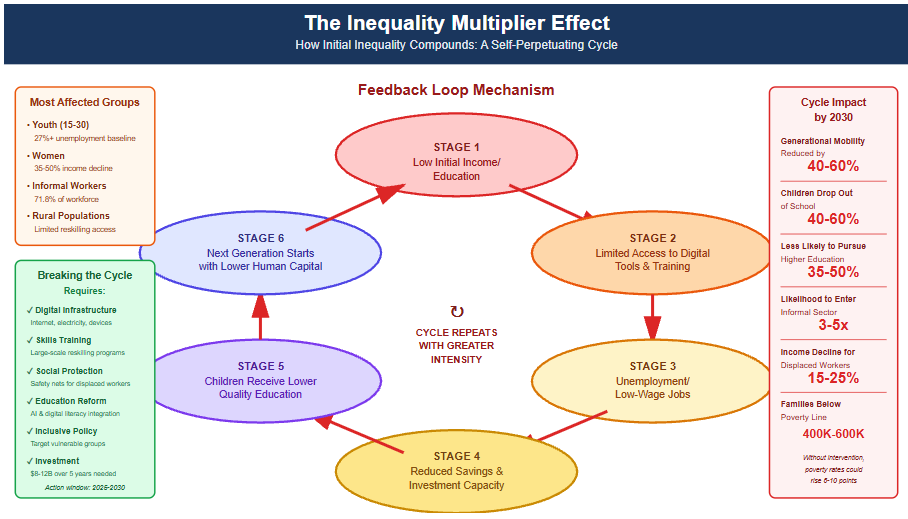
Third, the study highlights that unemployment and inequality are mutually reinforcing in the AI era. Job displacement pushes affected workers into low-pay, oversaturated informal activities, while rising inequality limits access to education, digital skills, and reskilling opportunities. This creates a self-perpetuating cycle in which vulnerable groups are increasingly excluded from emerging AI-enabled jobs, leading to intergenerational transmission of poverty and reduced social mobility. Without intervention, poverty rates could rise by 6–10 percentage points by 2030, and income concentration among the top 10% could exceed 50% of total national income.
Overall, the evidence confirms that AI is not a neutral technological force for Tanzania. Its impact on unemployment and income inequality will depend fundamentally on policy choices made in the next five years. Without timely investment in digital infrastructure, large-scale reskilling, inclusive education reform, and social protection for displaced workers, AI risks exacerbating existing labour market vulnerabilities and reversing recent development gains. Conversely, proactive and inclusive governance can mitigate job losses, narrow inequality gaps, and harness AI as a tool for shared prosperity.
In conclusion, the challenge facing Tanzania is not whether AI will transform the economy, but who benefits and who bears the costs of that transformation. The period from 2025 to 2030 represents a decisive window in which Tanzania must act to ensure that AI adoption supports employment creation, reduces inequality, and strengthens social cohesion rather than deepening unemployment and economic exclusion. Read More Of This Topic:What Will the Next Five Years Decide for Tanzania’s AI Future and Labour Market?
1. How AI Will Increase Unemployment in Tanzania
1.1 Mechanisms of Job Displacement
AI increases unemployment through four primary mechanisms:
1.1.1 Task Automation
AI systems directly replace human workers in routine, repetitive tasks across multiple sectors. In Tanzania, this particularly affects:
Data entry clerks (75% automation risk)
Customer service representatives (80% automation risk)
Retail cashiers (65% automation risk)
Bookkeeping and accounting clerks (45-55% automation risk)
1.1.2 Process Optimization
AI-driven efficiency gains reduce overall labor requirements even when individual jobs aren't fully automated. For example, AI-powered inventory management systems reduce the need for manual procurement staff in SMEs.
1.1.3 Productivity Substitution
In agriculture, AI-powered precision farming, automated irrigation, and drone-based crop monitoring reduce demand for manual farm labor. Without concurrent value-chain upgrading, productivity gains translate into job losses rather than income growth.
1.1.4 Skill Obsolescence
As AI systems advance, certain skill sets become obsolete, rendering workers unemployable in their current roles without significant retraining.
1.2 Sector-by-Sector Vulnerability Analysis
Sector
Current Employment
AI Automation Risk
Timeline
Expected Job Displacement
Agriculture
~28% of workforce (70% indirectly)
Moderate-High (40-60%)
2026-2029
200,000-400,000 positions
Customer Service & Call Centers
Growing BPO sector
Critical (70-80%)
2024-2026
50,000-75,000 positions
Administrative & Clerical
Common across all sectors
High (60-75%)
2025-2028
150,000-250,000 positions
Manufacturing & SMEs
44% of informal economy
Moderate-High (40-60%)
2026-2029
100,000-200,000 positions
Financial Services
Expanding rapidly
Moderate (30-50%)
2027-2030
30,000-60,000 positions
Retail & Sales
Large informal component
High (50-70%)
2025-2028
80,000-150,000 positions
Total Estimated Job Displacement: 610,000 - 1,135,000 positions by 2030
1.3 Timeline of Job Displacement
Period
Phase
Key Developments
Estimated Jobs Lost
2024-2025
Initial Impact
- Basic automation in customer service - Data entry elimination - Resume screening automation - 76,440 jobs eliminated globally
Youth (15-30 years): Facing 27% unemployment baseline, particularly vulnerable as entry-level positions are automated first. Evidence from Upwork shows a 21% reduction in jobs available for African freelancers since 2022, particularly affecting entry-level opportunities.
Women: Disproportionately employed in sectors with high automation risk:
58.87 million women in US workforce highly exposed to AI automation vs. 48.62 million men (WEF, 2025)
Overrepresented in customer service, administrative, and clerical roles
Informal Sector Workers: 71.8% of workforce lacks formal protections, skills training, or transition support
Rural Agricultural Workers: Limited access to reskilling opportunities, facing displacement from precision farming technologies
Low-Education Workers: 54% unaware of formalization or upskilling programs; limited ability to transition to AI-resistant roles
2. How AI Will Widen Income Inequality in Tanzania
2.1 Mechanisms of Inequality Expansion
AI widens income inequality through six interconnected mechanisms:
2.1.1 Skill Premium Amplification
AI creates a "winner-take-all" dynamic where highly skilled workers command dramatically higher wages while low-skilled workers face wage depression or unemployment.
Evidence:
77% of new AI jobs require master's degrees (Global studies, 2025)
AI specialists earn 150-300% premium over traditional roles
Entry-level positions see 20-40% wage compression due to AI competition
2.1.2 Capital-Labor Redistribution
AI-driven automation benefits favor capital over labor, widening inequality and reducing the competitive advantage of low-cost labor.
Tanzanian Context:
Productivity gains accrue to technology owners (multinational corporations, elite firms)
Workers face stagnant wages despite productivity improvements
Small-scale enterprises lack capital to invest in AI, falling further behind
2.1.3 Urban-Rural Digital Divide
Urban areas, with abundant educational resources and conducive innovation environments, can swiftly absorb and apply AI technology. Rural areas experience sluggish diffusion due to weak technological foundations and restricted information access.
Tanzania Disparities:
Dimension
Urban Areas
Rural Areas
Inequality Gap
Internet Access
45-60%
10-20%
3:1 ratio
Digital Literacy
35-50%
5-15%
5:1 ratio
Electricity Access
70-85%
20-40%
3:1 ratio
AI-Ready Jobs
Growing
Minimal
10:1 ratio
Average Income
$150-250/month
$40-80/month
3:1 ratio
2.1.4 Formal-Informal Sector Divergence
Formal sector workers gain access to AI tools, training, and productivity enhancements, while informal workers face displacement without support systems.
Projected Income Gap Expansion (2025-2030):
Formal sector wages: Expected growth of 25-35%
Informal sector wages: Expected stagnation or decline of 5-15%
Resulting inequality increase: 30-50% widening
2.1.5 Education-Based Stratification
AI development accelerates intelligent upgrading of industries, substantially increasing demand for high-skilled labor through enhanced educational resources and innovation environments.
Education and Income Correlation in AI Era:
Education Level
AI Exposure Risk
Income Trajectory 2025-2030
Employment Outlook
Primary or less
70-85% displacement risk
-10% to -25%
Critical
Secondary
50-65% displacement risk
-5% to +5%
High risk
Diploma/Vocational
30-45% displacement risk
+10% to +20%
Moderate
University degree
15-25% enhancement
+30% to +60%
Favorable
Advanced AI skills
Near zero risk
+100% to +300%
Excellent
2.1.6 Between-Country Divergence
Without strong policy action, gaps in economic performance, capabilities, and governance systems can grow, reversing the long trend of narrowing development inequalities.
Tanzania vs. Regional Competitors:
Country
AI Readiness Index
Digital Infrastructure
AI Investment
Expected Outcome
Kenya
6.2/10
Moderate-High
$150M+ annually
Moderate gains
Rwanda
7.1/10
High
$200M+ annually
Significant gains
Nigeria
5.8/10
Moderate
$300M+ annually
Mixed results
Tanzania
4.5/10
Low-Moderate
$50-80M annually
High inequality risk
2.2 Quantifying Income Inequality Expansion
2.2.1 Current Baseline (2025)
Gini Coefficient: Estimated 0.38-0.42
Income Ratio (Top 20% to Bottom 20%): 8:1
Urban-Rural Income Gap: 3.5:1
Formal-Informal Wage Gap: 2.8:1
2.2.2 Projected Impact by 2030 (Without Intervention)
Scenario 1: Moderate AI Adoption (50% of projections)
Gini Coefficient: 0.44-0.48 (+6-14%)
Income Ratio: 10:1 (+25%)
Urban-Rural Gap: 4.5:1 (+29%)
Formal-Informal Gap: 3.8:1 (+36%)
Scenario 2: High AI Adoption (75% of projections)
Gini Coefficient: 0.48-0.53 (+15-26%)
Income Ratio: 12:1 (+50%)
Urban-Rural Gap: 5.5:1 (+57%)
Formal-Informal Gap: 4.5:1 (+61%)
2.3 Geographic Concentration of Inequality
AI Benefits Concentration:
Region
% of AI-Related Jobs
% of Population
Inequality Index
Dar es Salaam
60-70%
11%
Extreme concentration
Arusha/Mwanza
15-20%
14%
High concentration
Other Urban
10-15%
22%
Moderate access
Rural Areas
0-5%
53%
Severe exclusion
3. The Compound Effect: Unemployment + Inequality
3.1 Synergistic Impact Mechanisms
Unemployment and inequality don't occur independently—they reinforce each other:
Unemployment → Inequality Amplification
Displaced workers enter oversaturated low-wage markets
Family incomes decline, reducing education investment
Generational poverty traps emerge
Inequality → Unemployment Acceleration
Poor families can't afford reskilling
Digital divide prevents access to emerging opportunities
Geographic immobility traps workers in declining sectors
3.2 Social and Economic Consequences
Expected Outcomes by 2030 (Without Intervention):
Dimension
Current State (2025)
Projected 2030
Change
Poverty Rate
26-28%
32-36%
+6-10 points
Youth Unemployment
27%
35-42%
+8-15 points
Informal Sector Size
71.8%
68-72%
Stagnant/growing
Rural-Urban Migration
Moderate
Accelerating
+40-60%
Social Protection Coverage
15-20%
12-18%
Declining
Income Concentration (Top 10%)
35-40%
45-52%
+10-12 points
3.3 Vulnerable Sectors Compound Analysis
Agriculture Sector Case Study:
Direct Employment: 28% of workforce (~10.1 million)
Indirect Engagement: 70% of population (~42.5 million)
AI Automation Risk: 40-60% of tasks
Expected Displacement: 200,000-400,000 direct jobs
Income Impact: 15-25% decline for displaced workers
Inequality Effect: Rural areas disproportionately affected, widening urban-rural gap by 40-50%
Service Sector Case Study:
Customer Service & Administrative: ~8-10% of formal employment
AI Automation Risk: 70-80%
Expected Displacement: 200,000-325,000 jobs
Income Impact: 30-50% wage decline for those remaining employed
Inequality Effect: Eliminates middle-income service jobs, creating "missing middle" phenomenon
4. Tanzania's Structural Vulnerabilities
4.1 Digital Infrastructure Deficit
Current State:
Infrastructure Component
Current Coverage
Required for AI Economy
Gap
Reliable Electricity
38% population
80%+
42-point gap
Internet Access
32% population
70%+
38-point gap
High-Speed Broadband
12% population
50%+
38-point gap
Digital Payment Systems
45% adults
80%+
35-point gap
Computer Literacy
25% workforce
60%+
35-point gap
Investment Requirements:
Estimated $8-12 billion needed over 5 years
Current annual investment: $1.2-1.8 billion
Funding gap: $6-10 billion
4.2 Human Capital Constraints
Critical Shortage of AI Professionals:
Current AI specialists: ~500-800 individuals
Required by 2030: 15,000-25,000 specialists
Gap: 95% of needed capacity
Educational System Challenges:
54% of workers unaware of formalization or digital upskilling programs
Limited STEM focus in secondary and tertiary education
Mismatch between education output and labor market needs
Low enrollment in technical and vocational training
4.3 Institutional Weaknesses
Governance Gaps:
No comprehensive AI strategy (expected late 2025)
Fragmented regulatory framework across multiple agencies
Limited public-private coordination mechanisms
Weak social protection systems (15-20% coverage)
Policy Implementation Challenges:
Slow bureaucratic processes (21% cite as barrier to formalization)
Limited budget allocation for workforce development
Urban-rural infrastructure gap among worst in region
Factor 4: Education-Skills Mismatch
54% of workers unaware of formalization/upskilling programs
Low STEM enrollment and quality
Vocational training capacity insufficient (serves <5% of potential beneficiaries)
Factor 5: Late Policy Action
National AI Strategy not expected until late 2025 (Kenya: 2023, Rwanda: 2022)
Limited regulatory framework
Fragmented governance across multiple agencies
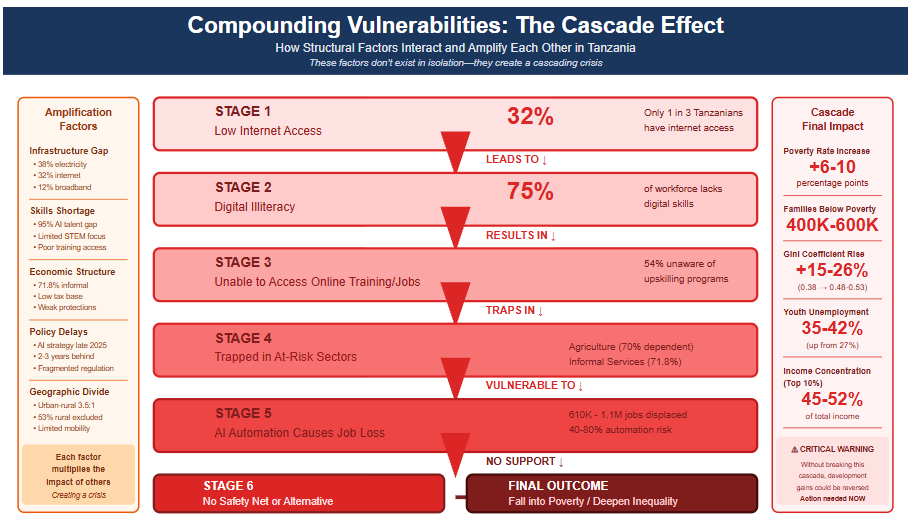
9.2 Compounding Vulnerabilities
These factors don't exist in isolation—they interact and amplify each other:
Example Cascade:
10. Conclusion
10.1 Summary of Key Findings
This research demonstrates that AI will significantly increase unemployment and widen income inequality in Tanzania between 2025 and 2030 through multiple interconnected mechanisms:
Unemployment Impact:
Estimated 610,000 - 1,135,000 jobs displaced across agriculture, customer service, administrative, manufacturing, financial services, and retail sectors
Timeline: 40,000-80,000 jobs (2024-2025), 200,000-350,000 (2025-2027), 370,000-705,000 (2027-2030)
Most vulnerable: youth, women, informal sector workers, rural populations, low-education groups
Inequality Expansion:
Gini coefficient projected to increase 15-26% (from 0.38-0.42 to 0.48-0.53)
Urban-rural income gap to widen 57% (from 3.5:1 to 5.5:1)
Formal-informal wage gap to expand 61% (from 2.8:1 to 4.5:1)
Top 20% to bottom 20% income ratio to grow 50% (from 8:1 to 12:1)
Digital infrastructure gaps (42-point electricity deficit, 38-point internet deficit)
Critical shortage of AI professionals (95% gap from needed capacity)
Late policy action (2-3 years behind regional peers)
10.2 The Window of Opportunity
The period 2025-2030 represents a decisive window for Tanzania. Without strong policy action, gaps in economic performance, capabilities, and governance systems can grow, reversing the long trend of narrowing development inequalities.
Current evidence already shows:
76,440 jobs eliminated globally by AI in 2025
21% reduction in jobs available for African freelancers since 2022
Strong correlation (0.47) between AI exposure and unemployment increases
Youth tech unemployment rising 3 percentage points in early 2025
However, Tanzania still has time to shape this transition. The country has begun laying foundations through the National AI Strategy (expected late 2025), AI research labs at University of Dodoma and NM-AIST, the Digital Tanzania Project, and sector-specific programs like AI4D Agriculture. The question is not whether AI will transform Tanzania's labor market, but whether the country will shape that transformation proactively or react to it too late.
10.3 Implications for Policy and Development
Critical Policy Imperatives:
Immediate Action Required (2025-2026)
Accelerate National AI Strategy implementation
Launch emergency digital literacy campaigns
Establish social protection for displaced workers
Create AI skills training programs at scale
Medium-Term Priorities (2026-2028)
Expand digital infrastructure nationwide
Reform education system to integrate AI/digital skills
Support SME technology adoption with subsidies
Develop ethical AI governance frameworks
Long-Term Investments (2028-2030)
Build domestic AI research and development capacity
Create incentives for AI-driven job creation sectors
Strengthen rural-urban connectivity
Establish inclusive innovation ecosystems
Without These Interventions:
Unemployment increases 8-15 percentage points
Income inequality worsens by 15-26%
400,000-600,000 families fall below poverty line
Generational mobility reduced by 40-60%
Development gains of past decades potentially reversed
With Proactive Policy:
Job displacement mitigated through reskilling
New AI-enabled opportunities created
Productivity gains shared more equitably
Formalization accelerates to 38-45% by 2030
Tanzania positions itself as regional AI hub
10.5 Future TICGL Research Directions
Further research is needed on:
Sector-Specific Deep Dives: Detailed studies of AI impact in agriculture, healthcare, education, and financial services in Tanzania
Longitudinal Tracking: Real-time monitoring of job displacement and creation patterns as AI adoption accelerates
Regional Comparative Studies: Systematic comparison of AI transition strategies and outcomes across East Africa
Social Protection Design: Evidence-based models for unemployment insurance and reskilling programs appropriate for informal sector contexts
Gender and Youth Focus: Targeted research on how AI affects women and young workers differently, with tailored intervention strategies
10.6 Final Reflection
The central finding of this research is clear: AI will increase unemployment and widen income inequality in Tanzania unless deliberate, inclusive, and well-sequenced policy interventions are implemented immediately. The next five years will determine whether Tanzania becomes an AI winner or loser.
The transformation is already underway globally—76,440 jobs eliminated in 2025, unemployment rising among AI-exposed occupations, and evidence of displacement spreading across sectors. Tanzania's structural vulnerabilities—71.8% informal employment, 70% agricultural dependence, severe digital divide, critical skills shortage—make the country particularly susceptible to AI-driven disruption.
Yet Tanzania also possesses unique advantages: a youthful population, late-mover learning opportunities, strong community values, and growing policy awareness. The country can choose to proactively shape an inclusive AI economy or reactively manage the fallout from mass displacement and deepening inequality.
The cost of inaction will be measured not only in lost jobs, but in lost development potential, widening inequality, and a generation left behind. The window for decisive action is now.
References
International Organization Reports
World Economic Forum (2025).Future of Jobs Report 2025. Geneva: World Economic Forum. Retrieved from
International Labour Organization (2025).World Employment and Social Outlook 2025: The Role of Digital Labour Platforms in Transforming the World of Work. Geneva: ILO.
United Nations Development Programme (2025).Human Development Report 2024-2025: Uncertain Times, Unsettled Lives – Shaping our Future in a Transforming World. New York: UNDP.
United Nations Conference on Trade and Development (2025).Digital Economy Report 2025. Geneva: UNCTAD.
UNESCO (2025).Tanzania AI Readiness Assessment 2025. Paris: UNESCO.
World Bank (2025).World Development Report 2025: The Changing Nature of Work. Washington, DC: World Bank Group.
St. Louis Federal Reserve (August 2025). "AI Exposure and Unemployment: Evidence from Occupational Data 2022-2025." Federal Reserve Economic Data (FRED).
Goldman Sachs Research (August 2025). "The Impact of Generative AI on Workforce Composition and Economic Growth." Goldman Sachs Economic Research Reports.
McKinsey Global Institute (2025).Jobs Lost, Jobs Gained: Workforce Transitions in a Time of Automation. McKinsey & Company.
Freire, C. (2025). "AI, Structural Change, and Income Inequality: A Multi-Country CGE Analysis." UNCTAD Research Paper Series, No. 95.
Zhang, Y., Chen, M., & Liu, S. (2025). "Artificial Intelligence, Income Distribution, and Economic Growth: A Theoretical Analysis." Sustainability, 17(1), 142. doi: 10.3390/su17010142
Korinek, A. & Stiglitz, J.E. (2025). "Artificial Intelligence, Globalization, and Strategies for Economic Development." NBER Working Paper, No. 33637.
Tanzania-Specific Studies
TICGL - Tanzania Institute of Capital Markets and Governance (April 2025).Tanzania Employment Analysis: Formal and Informal Sector Dynamics. Dar es Salaam: TICGL.
International Journal of Research and Innovation in Social Science (January 2025). "Artificial Intelligence in Non-Governmental Organizations: A Case Study of Kinondoni District, Tanzania." IJRISS, Vol. 9, Issue 1.
Right for Education Initiative (March 2025).AI Impact on African Labor Markets: Country Case Studies. Nairobi: Right for Education.
Digital Regenesys (November 2025).AI in Tanzania Strategy Report: Current State and Future Pathways. Johannesburg: Digital Regenesys Africa.
Policy Documents and Government Reports
United Republic of Tanzania (2025).National AI Strategy Framework (Draft). Ministry of ICT and Digital Economy, Dodoma.
United Republic of Tanzania (2025).National Digital Education Guidelines 2025. Ministry of Education, Science and Technology, Dodoma.
United Republic of Tanzania (2024).Digital Tanzania Project: Progress Report 2024. President's Office - Regional Administration and Local Government.
Think Tank and NGO Reports
Center for Global Development (2025).AI and Development: Opportunities and Risks for Low and Middle-Income Countries. Washington, DC: CGD.
Unaligned.io (2025).The Geographic Distribution of AI Development and Its Implications for Global Inequality. Retrieved from
Brookings Institution (2025).Artificial Intelligence and the Future of Work in Developing Countries. Washington, DC: Brookings.
Technology and Industry Reports
PwC (2025).AI Jobs Barometer 2025: Understanding the Impact of AI on the Labor Market. PricewaterhouseCoopers Global.
Upwork (2025).Global Freelancing Trends Report 2024-2025. Upwork Inc.
Eva Docs.ai (2025).Case Study: AI-Powered Procurement in Tanzania SMEs. Dar es Salaam: Eva Technologies.
Regional Comparative Studies
African Development Bank (2025).East Africa Economic Outlook 2025: Digital Transformation and Employment. Abidjan: AfDB.
East African Community (2025).Regional AI Strategy Framework for EAC Partner States. Arusha: EAC Secretariat.
Kenya National AI Taskforce (2023).Kenya National Artificial Intelligence Strategy. Nairobi: Ministry of ICT, Innovation and Youth Affairs.
Government of Rwanda (2022).Rwanda National AI Policy. Kigali: Ministry of ICT and Innovation.
News and Media Sources
The Citizen Tanzania (2024). "University of Dodoma Launches AI Research Lab with Sh1.8 Billion Investment." December 15, 2024.
Financial Times (2025). "AI's Uneven Impact: Why Developing Nations Face Greater Challenges." September 2025.
BBC Africa (2025). "African Freelancers See 21% Job Decline Amid AI Automation." August 2025.
Data Sources and Statistical Databases
International Labour Organization (2025).ILOSTAT Database. Retrieved from
World Bank (2025).World Development Indicators. Retrieved from
Tanzania National Bureau of Statistics (2025).Labour Force Survey 2024/2025. Dodoma: NBS.
Appendix A: Key Terms and Definitions
Artificial Intelligence (AI): Technologies that enable machines to perform tasks that typically require human intelligence, including machine learning, natural language processing, computer vision, and robotics.
Automation Risk/Potential: The percentage of tasks within a job that can be performed by AI systems, leading to either job displacement or significant job restructuring.
Formal Sector: Employment characterized by written contracts, social security benefits, legal protections, and regular wages.
Informal Sector: Economic activities not registered with government authorities, lacking formal contracts, social protection, and legal safeguards.
Gini Coefficient: A measure of income inequality ranging from 0 (perfect equality) to 1 (perfect inequality).
Digital Divide: The gap between those with access to digital technologies and those without, encompassing infrastructure, skills, and economic resources.
Skills Premium: Additional wages earned by workers with specialized skills relative to those with basic skills.
Appendix B: Policy Recommendations Matrix
Priority Level
Intervention
Target Group
Timeline
Estimated Cost
Expected Impact
CRITICAL
National AI Strategy Implementation
Whole economy
2025-2026
$50-100M
Framework for all actions
CRITICAL
Emergency Digital Literacy Program
10M workers
2025-2027
$200-300M
40% workforce upskilled
CRITICAL
Social Protection for Displaced Workers
500K-1M workers
2025-2030
$150-250M/year
Poverty prevention
HIGH
Digital Infrastructure Expansion
Rural areas
2025-2029
$2-3B
60% connectivity
HIGH
AI Skills Training Centers
Youth, educated
2026-2028
$100-150M
50K AI professionals
HIGH
SME Technology Adoption Subsidies
200K businesses
2026-2030
$300-500M
Productivity boost
MEDIUM
Education System Reform
Students
2026-2030
$400-600M
Future-ready workforce
MEDIUM
Rural-Urban Digital Bridge
Rural populations
2027-2030
$500-800M
Reduce geographic inequality
MEDIUM
Women and Youth Support Programs
Women, youth
2025-2030
$150-250M
Reduce gender/age gaps
About the Author
Amran Bhuzohera is a researcher focusing on labor markets, digital transformation, and development economics in East Africa, with particular emphasis on Tanzania's economic transition in the age of artificial intelligence.
Report Compiled: December 2025 Geographic Focus: Tanzania with global and regional context Time Horizon: 2025-2030 Document Version: 1.0
Recommended Citation: Bhuzohera, A. (2025). AI's Impact on Unemployment and Income Inequality in Tanzania: A Comprehensive Analysis (2025-2030). Dar es Salaam: Independent Research Report.
Keywords: Artificial Intelligence, Tanzania, Labor Market, Unemployment, Income Inequality, Informal Sector, Agriculture, Digital Transformation, Skills Gap, Development Economics, East Africa, Automation, Job Displacement, Digital Divide, Policy Intervention