
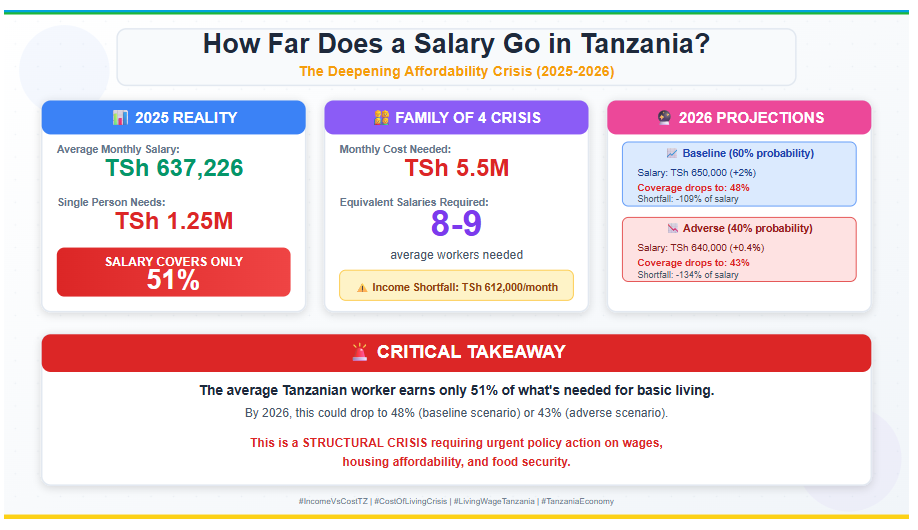
Tanzania is facing a deepening affordability challenge as the gap between household incomes and the cost of living continues to widen. In 2025, the average monthly salary stands at TSh 637,226, yet a single person requires approximately TSh 1.25 million per month to meet basic living expenses—equivalent to 196% of the average salary. This leaves an income shortfall of nearly TSh 612,000, meaning the typical worker earns only 51% of what is needed to live modestly. The situation is far more severe for families: a household of four needs about TSh 4.75 million per month for a moderate lifestyle and closer to TSh 5.5 million to remain financially stable—an amount equal to the combined earnings of 8–9 average workers. Looking ahead to 2026, projections suggest the crisis will intensify. Under the baseline scenario, salaries rise marginally to TSh 650,000 (+2%), while living costs for a single person increase to TSh 1.36 million, widening the deficit to -109% of salary. In an adverse scenario, workers may earn only 43% of their basic needs, with family living costs exceeding TSh 6.6 million per month. These figures highlight a structural imbalance where economic growth and wage adjustments are failing to keep pace with rising living costs—signaling an urgent need for policy action on wages, housing affordability, and food security. More On This Topic: Is the Cost of Living in Tanzania Outpacing Incomes as We Enter 2026?
| Category | Amount (TSh) | % of Salary |
| Average Monthly Salary | 637,226 | 100% |
| Monthly Living Cost | 1,249,000 | 196% |
| Income Shortfall | -611,774 | -96% |
Key Insight: A single person needs to earn nearly double the average salary just to cover basic expenses.
| Category | Amount (TSh) | Equivalent Salaries Needed |
| Single Average Salary | 637,226 | 1 person |
| Family Monthly Cost | 4,750,000 | 7.5 people |
| Required Household Income | 5,500,000 | 8.6 people |
Key Insight: A family needs the combined income of 8-9 average workers to live moderately—typically requiring 2 high-earning adults plus additional income sources.
| Metric | 2025 | 2026 Baseline | 2026 Adverse |
| Avg. Monthly Salary | 637,226 | 650,000 (+2%) | 640,000 (+0.4%) |
| Single Person Cost | 1,249,000 | 1,360,000 | 1,500,000 |
| Income Shortfall | -611,774 (-96%) | -710,000 (-109%) | -860,000 (-134%) |
| Salary Coverage | 51% of needs | 48% of needs | 43% of needs |
The average Tanzanian worker currently earns only 51% of what's needed for basic living. By 2026, this could drop to 48% (baseline) or 43% (adverse scenario).
This isn't just an income problem—it's a structural crisis requiring urgent policy action on wages, housing affordability, and food security.
Tanzania's deepening cost-of-living crisis reveals a profound structural disconnect between wages and essential expenses. In 2025, the average monthly salary of TSh 637,226 covers only 51% of a single person's basic needs (TSh 1.25 million) and forces families of four to rely on the equivalent of 8–9 average incomes to achieve modest financial stability (TSh 5.5 million). Projections for 2026 indicate further deterioration: under the baseline scenario, salary coverage falls to 48% for individuals, with family costs rising toward TSh 6 million; in the adverse scenario, workers may earn just 43% of their needs, pushing family expenses beyond TSh 6.6 million.
These trends signal that economic growth and wage adjustments are failing to keep pace with inflation in housing, food, and other essentials. Without urgent, targeted policy interventions—raising living wages, improving housing affordability, strengthening food security, and promoting inclusive growth—the affordability gap will widen further, eroding living standards and deepening inequality for millions of Tanzanians. Addressing this crisis is not only an economic imperative but a moral one, essential for building a more equitable and sustainable future.